
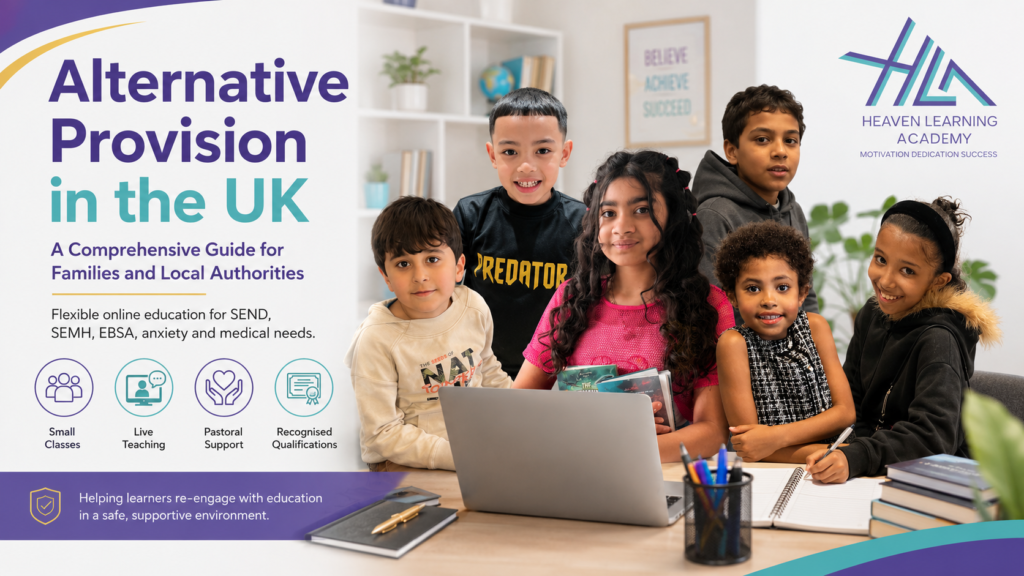
A Comprehensive Guide for Families and Local Authorities.
Supporting Families and Councils to Strike the Ideal Mix of Academic Achievement, Pastoral Support, and Flexibility
Selecting the right educational pathway for your child is among the most significant choices you will make as a parent. In recent years, alternative provision and online learning have grown rapidly across the United Kingdom. It is no longer seen solely as a short-term emergency solution or a stopgap. For many households and local councils, a well-organised online school UK operating as an alternative provision provider can provide stability, adaptable schedules, recognised qualifications, and a more tailored, student-centred learning experience.
Families explore alternative education for a wide range of reasons. Some may be moving home or living abroad, while others require flexible schooling due to physical medical needs, special educational needs and disabilities (SEND), high-level sporting commitments, anxiety, neurodivergence, or emotionally based school avoidance (EBSA). Other parents simply seek smaller class sizes, more personalised support, and a calm setting that better fits their child’s emotional wellbeing.
With so many organisations now providing virtual tuition, it is vital to look past polished marketing promises. Parents and commissioning authorities should thoroughly scrutinise teaching standards, safeguarding processes, academic routes, pastoral care, and exam arrangements before committing.
This handbook highlights the key areas every parent, carer, and local authority officer should weigh up when exploring alternative provision and online education in the UK.
1. What is Alternative Provision and Who Qualifies?
Alternative Provision (AP) refers to education arranged by local authorities or mainstream schools for pupils who, due to illness, exclusion, or other reasons, would not otherwise receive a suitable full-time education. Under statutory guidance in the United Kingdom, local councils have a legal duty to ensure every child has access to full-time learning that aligns with their age, ability, and aptitudes.
A pupil may qualify for alternative education through a school referral, an EHCP education provider allocation, or a direct commissioned education provider agreement from local authority education departments.
Key Learner Profiles Who Qualify for AP:
- Pupils with SEMH Needs: Children requiring SEMH provision (Social, Emotional, and Mental Health) who find mainstream classroom dynamics challenging.
- Students Experiencing EBSA: Children facing Emotionally Based School Avoidance (EBSA education) triggered by severe anxiety, sensory overload, or social difficulties.
- Learners with SEND: Autistic students, pupils with ADHD, or those with complex learning needs seeking an online school for SEND.
- Children with Medical Needs: Pupils recovering from operations, managing chronic fatigue, or undergoing long-term medical treatments.
- Excluded Pupils: Children who have been permanently excluded or are at risk of exclusion from mainstream settings.
2. Can Alternative Provision Help a Child with Anxiety?
Severe anxiety can cause significant disruption to a young person’s educational journey. The pressure of navigating crowded corridors, noisy classrooms, and complex peer dynamics can make attending a physical school a source of acute daily distress.
An online school for anxiety removes these physical environment stressors while maintaining academic rigour. By shifting learning into a safe, calm home setting, children can focus on their studies without constant sensory and social triggers.
Live online lessons allow students to engage at a pace that feels secure. Learners can interact initially through typed chat before gradually building the self-belief to turn on microphones or cameras, ensuring complete inclusion without psychological distress. Through trauma-informed education and dedicated inclusion support, online AP providers help anxious learners restore trust in the learning process and steadily regain their self-worth.
3. Alternative Provision for School Refusers (EBSA)
Emotionally Based School Avoidance (EBSA education) is a complex issue rooted in severe emotional distress rather than deliberate truancy. For an EBSA student, forcing physical school attendance often heightens panic and deepens feelings of isolation.
An online education for school refusal strategy focuses on gentle, structured re-engagement. Rather than demanding immediate full-time classroom attendance, a reputable British online school establishes a predictable routine that lowers anxiety and builds trust.
Managing Screen Time with Healthy Routines
Parents frequently express concern about increasing device use when moving to virtual schooling. However, there is a distinct difference between passive recreational screen time and structured, interactive **online learning for children**. A balanced educational schedule combines live teacher-led sessions with independent tasks, physical breaks, and off-screen reflection, establishing healthy screen time habits that support overall mental wellbeing.
4. Alternative Provision vs Mainstream School
To understand why a flexible online education model works so effectively for vulnerable learners, it helps to compare traditional schooling with a specialised online AP environment:
- Class Environment: Mainstream schools often operate with 25 to 30+ pupils in busy, sensory-heavy rooms. A small class online school setting provides a quiet, low-sensory home environment where pupils can concentrate without distraction.
- Teaching Delivery: Mainstream environments rely on fixed physical presence and rigid timetables. Online AP delivers real-time live online lessons combined with accessible digital portal resources.
- SEND and SEMH Support: Resource constraints in mainstream settings often mean a generalised whole-class pace. Personalised online learning adapts directly to individual EHCP targets, ADHD learning strategies, and online school for autism needs.
- Flexibility: Traditional schools enforce strict physical attendance rules. Online AP offers flexible schooling schedules that accommodate medical care, therapy, and fluctuating energy levels.
5. Alternative Provision for Children with Medical Needs
Children living with long-term medical conditions, severe physical illnesses, or ongoing hospital stays frequently miss continuous stretches of physical schooling. This disruption can lead to knowledge gaps, academic stress, and social disengagement.
An online school for medical needs provides continuous learning that adapts around hospital appointments, fluctuating energy levels, and treatment regimes. Whether a pupil resides in London, Birmingham, Manchester, Luton, Bedford, Milton Keynes, Hertfordshire, Surrey, Kent, or Essex—or studies internationally from Dubai, Abu Dhabi, Doha, or Riyadh—virtual platforms allow uninterrupted access to high-quality education anywhere with a stable internet connection.
By delivering the British National Curriculum and Cambridge Curriculum, children can keep pace with their peers and maintain continuous academic momentum during medical challenges.
6. What Happens After School Exclusion?
A permanent exclusion does not mark the end of a young person’s educational ambitions. Local authorities have a statutory responsibility to arrange suitable, full-time education from the sixth day of an exclusion.
As an approved alternative provision and EOTAS provider UK (Education Other Than At School), an online provider collaborates with local councils to re-establish stability rapidly.
- Rebuilding Foundation Skills: For students who have missed core learning, targeted courses such as Functional Skills English Online and Functional Skills Maths Online offer accessible, nationally recognised qualification pathways.
- GCSE and IGCSE Preparation: Excluded pupils receive structured guidance in core subjects, ensuring they achieve essential qualifications for post-16 progression.
- Behavioural & Emotional Re-engagement: Through trauma-informed education, staff help students process past challenges, regulate their behaviour positively, and rebuild confidence in their capabilities.
7. Is Online Alternative Provision Right for My Child?
Selecting an online private school UK or an online alternative education route is a pivotal decision for any family or local authority officer. Online AP provides an ideal setting for pupils who thrive in smaller groups, require a controlled sensory environment, or need flexible learning structures.
Recognised Qualifications and Academic Pathways
Online schools prepare students for recognised qualifications rather than awarding the certificates directly. Official qualifications are granted by accredited awarding bodies (such as Cambridge International, Pearson Edexcel, or AQA) upon the completion of examinations sat at registered exam centres. A quality provider assists families and local authorities in identifying and coordinating with approved local examination centres.
Academic pathways available to pupils include:
- Online GCSE and International GCSE (IGCSE) awards
- Cambridge IGCSE Online and Cambridge A Level Online pathways
- Online Sixth Form programmes
Live Teaching vs On-Demand Lessons
Online learning is not delivered in one uniform format. Some providers depend largely on on-demand, pre-recorded lessons paired with self-directed study, which can limit live interaction, reduce accountability, and restrict timely feedback.
Live online teaching works differently. Students join real-time classes led by qualified teachers, ask questions, take part in discussions, and receive immediate guidance. This structured routine helps learners build momentum and maintain consistent progress.
Teacher Qualifications and Virtual Pedagogy
The standard of any school rests largely on the expertise, experience, and dedication of its teaching staff. Online educators require subject mastery as well as specialised training in virtual pedagogy. They must know how to communicate clearly, run digital classrooms effectively, promote active participation, maintain professional boundaries, and recognise when a student seems upset, disengaged, or requires extra help.
Safeguarding Standards in Online Learning
Safeguarding sits at the centre of every reputable online school. Parents and local authorities should expect strict suitability vetting—including enhanced DBS checks where required—completed before staff work with pupils. All welfare concerns are managed by a trained Designated Safeguarding Lead (DSL) in alignment with DfE standards and the Online Education Accreditation Scheme (OEAS) framework.
Attendance, Engagement, and Parent Portals
Remote education should still offer a clear routine alongside consistent expectations for attendance. Attendance should be marked in live sessions, with absence trends tracked and communicated to families. Dedicated parent portals or regular progress reports keep families fully informed regarding attendance, lesson participation, and academic attainment.
When non-attendance is connected to anxiety, medical needs, or EBSA, the school takes a supportive approach to help the learner re-engage safely.
Examination-Centre Arrangements
While tuition can be delivered online, official GCSE, IGCSE, and A Level exams must be sat in person at a recognised, approved exam centre. A trusted provider supports families in finding an appropriate local centre, verifying registration deadlines, and assisting with documentation for access arrangements (such as extra time, rest breaks, readers, or scribes).
University, Careers, and UCAS Support
Older learners working towards university entry require guidance that extends beyond subject lessons. Comprehensive UCAS Support—including Personal Statement Support, university admissions guidance, Oxbridge Preparation, and specialised Medicine Application Support (including UCAT and LNAT practice)—ensures non-traditional educational routes lead directly to top higher education institutions, including Russell Group universities.
Fees and Financial Transparency
Clear pricing matters when selecting a private online school or commissioning alternative provision placements. Reliable providers avoid misleading claims and instead state clear and transparent information about tuition fees and additional charges (such as exam centre registration fees, specialist 1-to-1 tuition, or specific subject materials) upfront prior to enrolment.
8. Why Choose Heaven Learning Academy?
Heaven Learning Academy is a UK online school and alternative provision provider supporting learners across the United Kingdom and internationally.
We deliver real-time, teacher-led classes Monday to Friday in a structured, nurturing virtual setting. Our approach is built to strengthen academic attainment, self-belief, independence, and active engagement.
Learners benefit from small class sizes, structured homework and regular assessments, attendance tracking, pastoral care, and targeted support for additional learning requirements. We prepare students for recognised qualifications—including Cambridge International routes—and assist families with exam logistics, post-16 planning, and UCAS university applications.
We collaborate closely with parents and local authorities to gain a clear picture of every student’s background, personal needs, and future goals. Our mission is to offer a safe, supportive, and academically focused environment where learners can re-engage with schooling and progress towards reaching their full potential.
9. Contact Heaven Learning Academy
Selecting the best alternative provision takes thoughtful evaluation of your child’s academic, wellbeing, and practical needs. To find out more about Heaven Learning Academy or to book an admissions consultation, please get in touch with our team:
Website: www.heavenlearningacademy.net
Email: admin@heavenlearningacademy.net
Telephone: +44 (0)20 8432 3416
WhatsApp: +44 (0)7596 107552
Location: United Kingdom